


Everyone wants AI SDRs. Autonomous outreach. Personalization at scale.
But most teams are trying to run Level 4 plays on a Level 1 foundation. The result? Expensive chaos.
Your reps aren’t slow. Your sequences aren’t broken. Your problem is upstream—and it’s been there since before you bought your last three tools.
The Real Problem Isn’t Tools. It’s the lack of a coherent martech Strategy.
I’ve audited dozens of SMB marketing and sales stacks. The pattern is almost universal:
- Someone saw a demo at a conference and bought a CDP
- Leadership read about AI personalization and demanded it yesterday
- A competitor mentioned their “intent data platform” on a podcast, so now you need one too

The result is a Frankenstein stack. Tools that don’t connect, and end up being largely shelf-ware. Implementing a demand gen stack requires that you walk before you run. Sadly though, most SMB teams are trying to sprint on a broken ankle.
The Solution: A Capability-driven tech stack planning
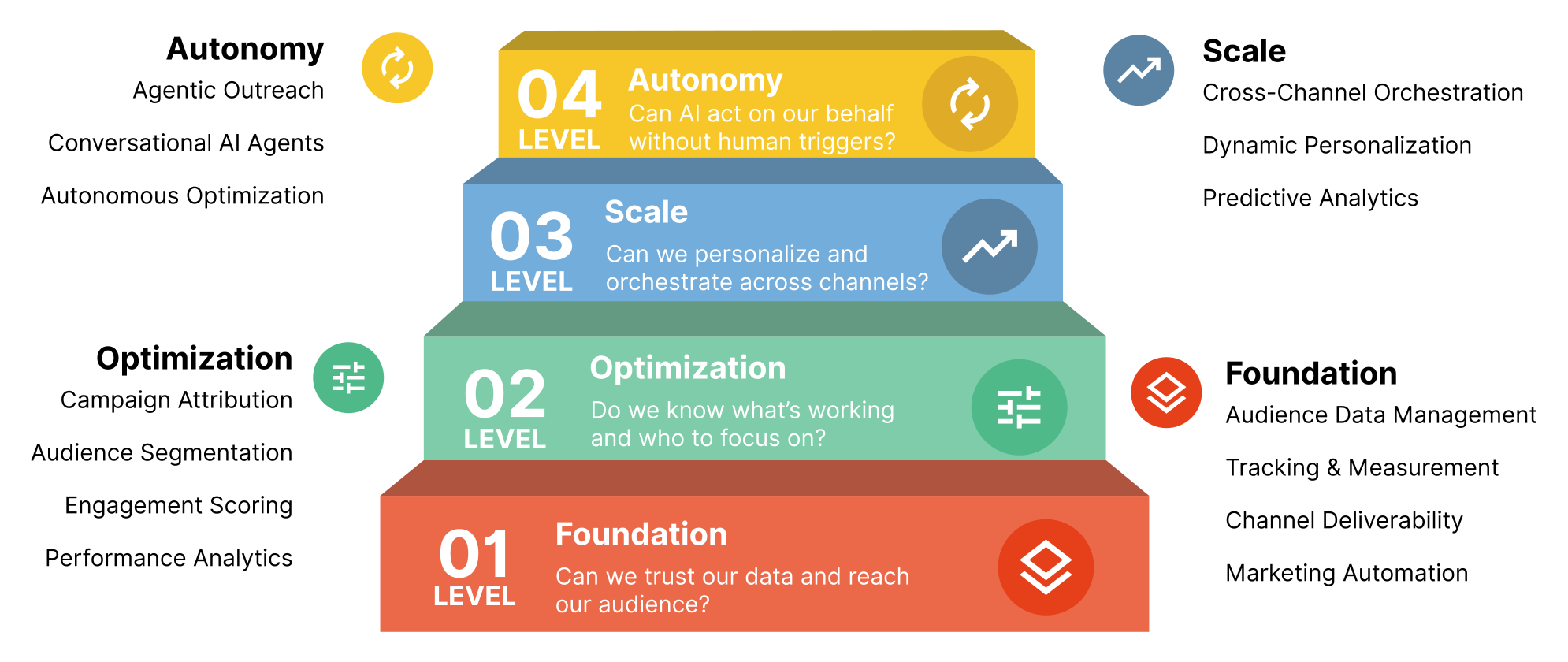
I use a four-level capability planning framework when planning demand gen stacks:
| Level | Focus | Examples |
|---|---|---|
| Level 1: Foundation | The basics that everything else depends on | Audience data management, tracking, deliverability, basic automation |
| Level 2: Optimization | Making what you have work harder | Attribution, segmentation, scoring, analytics |
| Level 3: Scale | Coordinating across channels | Cross-channel orchestration, dynamic personalization, predictive analytics |
| Level 4: Autonomy | AI acting without human triggers | Agentic outreach, conversational AI, autonomous optimization |
Notice where Audience Data Management sits. Level 1. Foundation. The absolute floor.
Skip this and everything above it breaks.
You can’t segment an audience you don’t have clean records for. You can’t score leads when half your data is outdated. You can’t attribute revenue to campaigns when contacts are duplicated across three systems. And you definitely can’t let AI loose on garbage data—that’s just automating your mess at scale.
What "Good" Looks Like at Level 1
Before you buy another tool, ask yourself: is my Audience Data Management capability actually solid?
Here’s the checklist:
Deduplicated records. One contact = one record. Not three versions of the same person across marketing, sales, and support systems.
Enriched firmographics. You know the company size, industry, tech stack, funding stage—not just a name and email.
Verified contact details. Emails that don’t bounce. Direct dials that actually connect. Job titles that reflect reality, not what someone typed three years ago.
Data that refreshes. Your system catches job changes automatically. When your champion moves to a new company, you know about it—and you have their new details.
Clean ICP alignment. Your data reflects who you actually want to sell to, not just whoever ended up in your CRM over the years.
If you can’t check all five boxes, you’re not ready for Level 2. And you’re definitely not ready for the AI-powered everything that vendors are pitching you.
The Fix: Stop Buying Up. Start Building Down.
Most SMBs buy martech top-down. They see the flashy Level 4 capability (AI! Autonomous! Agentic!) and assume the foundation will sort itself out.
It won’t.
The companies that actually get results build bottom-up:
- Fix the data foundation first
- Prove it works (deliverability up, bounce rates down, rep time reclaimed)
- Then add the next capability layer
- Let ROI from Level 1 fund Level 2
This is why I point clients toward platforms that treat data quality as a core function—not an afterthought or an add-on.
Over the years, I have tried a number of platforms including Insideview(now Demandbase), Lusha, and ZoomInfo, but Apollo.io has always been my top choice for Audience Data Management at Level 1. Here’s why:
- 275M+ contacts with verified emails and direct dials
- Real-time enrichment that keeps your CRM data fresh automatically
- Job change alerts so you know when champions move (and can follow them)
- Intent signals baked in, so when you’re ready for Level 2, the data’s already there
- Pricing that doesn’t assume you’re an enterprise with unlimited budget
- Well-documented API that helps building custom integrations
It’s not the only option. But it’s the one I’ve seen work consistently for SMBs who need to fix their foundation without burning six months and six figures on a “data transformation project.”

Need help planning this?
Getting Audience Data Management right isn’t about buying Apollo and hoping for the best. It’s about designing the architecture before you touch the tool. Here are specific deliverables that I can help you with:
Deduplication & Matching Logic Spec
Documented rules for identifying duplicates, merge hierarchy, and exception handling—ready to hand off to ops or your integration partner.
ICP & Segmentation Framework
Translate your ideal customer profile into a structured taxonomy—firmographics, technographics, persona definitions—with documented filter logic.
Integration Data Flows
Visual architecture showing how Apollo connects to your CRM and marketing automation. What syncs, in which direction, and under what conditions.
Data Taxonomy & Field Architecture
Define your contact and account data model: field names, data types, picklist values, and enrichment mappings. A spec your CRM admin can implement directly.
Enrichment Strategy Document
Which fields to enrich, from which sources, at what frequency, and how job changes trigger workflow updates.
If you’re not sure whether your foundation needs work, I’m happy to spend 15 minutes on a call and tell you what I see. No pitch, no pressure—just an honest read on where you stand.


