

Your demand generation data/technology stack doesn’t align to your priorities — and you don’t have a structured way to fix it. Budget is not as a big a challenge as knowing how and where to spend it. That’s not a tools problem. It’s a strategy problem. Enterprises pay consultants millions to solve this. Here’s a structured approach to how to do it yourself, with or without external help.
The Mindset Shift: Start with capabilities, not tools
Most SMBs build their martech stack backwards. They buy tools based on:
- Whatever got pitched at the last conference. The next ‘Agentic’ thing
- Whatever their competitor mentioned on a podcast
- Whatever has the most buzz on LinkedIn this month

“We need a CDP!” (Do you? Can you even use the data you already have?)
“We need AI personalization!” (Is your tracking even working first?)
The result: a Frankenstein stack that doesn’t connect, data that doesn’t flow, and a team that ignores half of it.
Before you start investigating tools, get a clear idea of the specific business capabilities that you need those tools to enable.
A capability is different from a tool. A tool is software you pay for. A capability is something your marketing org NEEDS TO DO—reliably, repeatedly, and at scale in order to support a specific business need.
You might own three tools that claim to do campaign “attribution” because the vendors did their job well. But did they actually tell you the kind of data you would need to assemble? Are you geared up for that technically and politically? Are the results expected to outweigh the capex/opex?
Good if you do, but in all likelihood you have procured shelfware. And for SMBs, wasted investments in data/tech are a big deal. What you need is a system that matches your technology stack to what you actually need, now, mid-term and in the long haul. That is what a capability-led planning allows you to do.
Capability-Driven Martech Stack Planning
Before you start to get lost in fluff, here is a visual summary of the capability stack that we are talking about – divided into four increasingly complex levels.

Each level consists of multiple capabilities with a progression from left to right. You build the left-most capability first and then progress within the level.
Level 1: Foundation
The absolute basic set of capabilities that you need for any meaningful demand generation stack.
| Capability | What it does | Skip this and… |
| Audience Data Management | Maintain clean, unified contact/account records | You’re marketing to garbage data |
| Tracking & Measurement Setup | Capture website and campaign interactions accurately | You’re flying blind on what’s working |
| Channel Deliverability | Ensure emails land in inbox, ads reach real humans | Your spend is wasted before it starts |
| Basic Marketing Automation | Trigger simple workflows based on behavior | Everything stays manual and slow |
You’re not ready for Level 2 until:
- Your CRM data is deduplicated and enriched
- Your website tracking captures the full journey (not just pageviews)
- Your email deliverability is above 95%
- You have at least one automated nurture running
Level 2: Optimization
Foundation's in place. Now make it work harder before adding more.
| Capability | What it does | Skip this and… |
| Campaign Attribution | Connect marketing touches to pipeline and revenue | You can’t defend your budget |
| Audience Segmentation | Group contacts by behavior, fit, and intent | Everyone gets the same message |
| Engagement Scoring | Identify who’s heating up vs. going cold | Sales chases the wrong leads |
| Performance Analytics | Report on what’s actually driving results | You optimize based on vanity metrics |
You’re not ready for Level 3 until:
- You can report on marketing-sourced pipeline (not just MQLs)
- You have at least 3 actionable segments beyond “all contacts”
- Your scoring model is used by sales, not ignored
- You know which channels actually convert
Level 3: Scale
Can we personalize at scale and orchestrate across channels without creating chaos?
| Capability | What it does | Skip this and… |
| Cross-Channel Orchestration | Coordinate messaging across email, ads, site, sales | Channels compete instead of reinforce |
| Dynamic Personalization | Tailor content to segment, behavior, or account | Your marketing feels generic at scale |
| Predictive Analytics | Forecast outcomes, surface hidden opportunities | You’re always reactive, never proactive |
- You coordinate messaging across 3+ channels
- Content adapts based on segment or behavior automatically
- You have predictive signals informing prioritization
- Your data foundation is solid enough to trust AI with decisions
Level 4: Autonomy
Can AI act on our behalf without human triggers?
| Capability | What it does | Skip this and… |
| Agentic Outreach Automation | AI agents that research, write, send, and follow up — without human in the loop | You’re paying for AI to automate your mess |
| Conversational AI Agents | AI chat/voice that qualifies visitors, answers questions, books meetings autonomously | You bottleneck every inbound lead through humans |
| Autonomous Campaign Optimization | AI that adjusts bids, budgets, targeting in real-time without human approval | You’re always a step behind the algorithm |
Why Sequence Matters (A Real Example)
Company A: Buys a CDP ($30K/year) before fixing their data foundation.
- Integrates 4 tools into the CDP
- Realizes the data coming in is full of duplicates and missing fields
- Spends 6 months cleaning data inside the CDP
- Could have done it for free in their CRM first
- CDP renewal comes up—they’ve barely used the advanced features
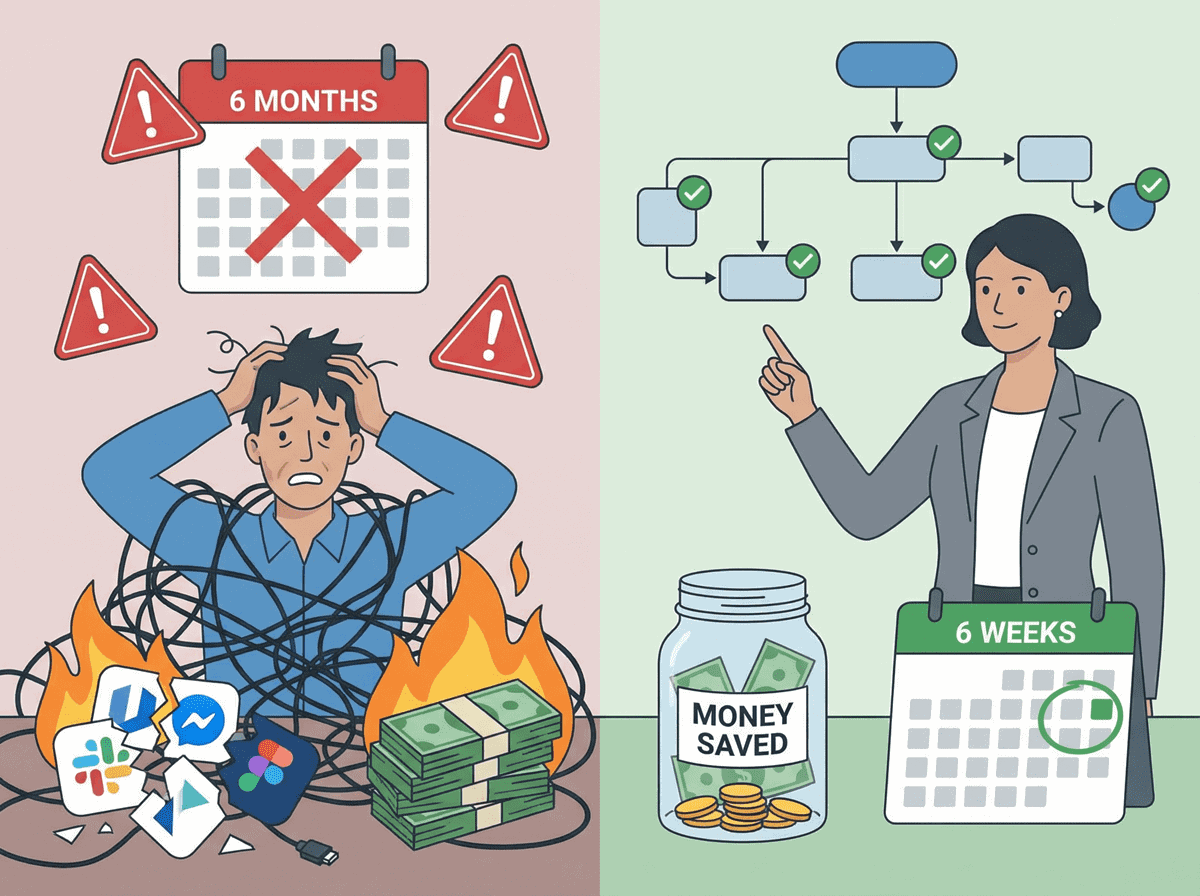
Company B: Fixes foundation first.
- Cleans CRM data, fixes tracking, builds basic automation
- Understands their data model and what’s actually needed
- THEN evaluates CDP options with clear requirements
- Buys a simpler (cheaper) solution that fits their actual needs
- Live in 6 weeks, not 6 months
Same category of tool. Wildly different outcomes. The difference is sequence. Capabilities within and across levels must be built in a specific sequence to realize the optimal business outcomes.
The SMB Reality Check
Let’s be honest about constraints:
Enterprise | SMB |
Dedicated marketing ops team | “Ops” is 20% of someone’s job |
$100K+ annual martech budget | $15-40K if you’re lucky |
6-month implementation timelines | Need results in 6 weeks |
Custom integrations and dev resources | Zapier, native integrations, and prayers |
Specialized roles (analytics, automation, data) | Generalists doing everything |
$200K consulting engagement to plan the stack | Google and guesswork |
That last row is the real problem. Enterprises don’t buy tools randomly—they hire Deloitte or Accenture to map their needs, sequence their investments, and build a roadmap. Then they execute against it.
SMBs get the same vendor pitches but none of the strategic planning. So you end up buying tools one at a time, based on whatever pain is loudest that quarter, and hope they somehow fit together.
A capability-driven approach brings that enterprise-level strategic thinking to SMB budgets:
- Sequential, not simultaneous — Build one capability at a time, prove it works, then move on
- ROI-first — Each stage should pay for the next before you invest further
- Tool-agnostic — Focus on what you need to do, then find the simplest tool that does it
- Realistic timelines — 4-8 weeks per capability, not 6-month “transformation projects”
You don’t need a $200K consulting engagement. You need a framework that respects your constraints.
Marketing Technology Stack Planning-The SMB Solution
| # | Deliverable | What it does |
|---|---|---|
| 1 | Maturity Assessment | Scorecards to diagnose current vs. target state |
| 2 | Future-State Architecture | Tool-agnostic data flow diagram of your systems and integrations |
| 3 | Technology Migration Roadmap | Sequenced build plan with dependencies and milestones |
| 4 | Tools Matrix | Vendor options by category with pros, cons, and pricing |
| 5 | Implementation Playbook | Step-by-step guide you can hand to any technical team to begin the build |
| 6 | Commercial Estimates | Software and agency costs with 3-year projections |
| 7 | SOW Template | Client-ready scoping document with timeline, deliverables, and pricing |
Questions?
No. This is a specialized Marketing Technology (MarTech) consultancy. While business consultants focus on “what” your goals should be, I focus on the “how” of the technology. I take your existing business goals and capabilities and translate them into a technical roadmap that ensures your software investments actually deliver results.
Most SMBs own “shelfware”—tools that are paid for but underutilized or misaligned. A Blueprint prevents the “Frankenstein stack” by auditing what you have and identifying the specific gaps in your data and technology flow. The goal is to ensure your tools talk to each other and support a logical progression from foundation to autonomy.
Not at all. The framework is designed specifically for SMB constraints. The focus is on sequential growth—building one capability at a time so that the ROI from Level 1 pays for Level 2. I help you find tool-agnostic solutions that fit a $50k–$250k budget, rather than the $Million+ budgets typically seen in enterprise firms.
One of the most common mistakes is “automating a mess.” You are ready for Level 4 once your data foundation is clean (Level 1), your attribution is clear (Level 2), and your orchestration is working across channels (Level 3). My assessment will tell you exactly where you sit on this maturity curve.
It means we stop looking at shiny software features and start looking at what your team needs to do—reliably and at scale. For example, “Audience Segmentation” is a capability; a CRM is just a tool. We define the capability first, then find the simplest technology to enable it.
You receive a prioritized, technical Statement of Work (SOW). This includes
- Future-state conceptual technical architecture of your data flows (tool-agnostic)
- Technology migration roadmap
- Tools Matrix with pros and cons of each
- Step-by-step implementation playbook that you can hand to any technical team to begin the build
- Commercial estimates including software, and agency costs
The scope covers ALL the capabilities identified above.
Absolutely. Please reach out to me on dheerajs@datawhistl.com. Sanitized copies of actual deliverables can be provided on request.
Simple. Transparent. No hidden costs. Blueprinting engagements typically range between $30-50K.